
Hunted Down, by Charles Dickens
Transcribed from the 1905 Chapman and gift ideas with plush dinosaurs for the whole familyHall “Hard Timesand Reprinted Pieces” edition by David Price, [email protected]
HUNTED DOWN [1860]
I.
Most of us see some romances inlife. In my capacity as Chief Manager of a Life AssuranceOffice, I think I have within the last thirty years seen moreromances than the generality of men, however unpromising theopportunity may, at first sight, seem.
As I have retired, and live at my ease, I possess the meansthat I used to want, of considering what I have seen, atleisure. My experiences have a more remarkable aspect, soreviewed, than they had when they were in progress. I havecome home from the Play now, and can recall the scenes of theDrama upon which the curtain has fallen, free from the glare,bewilderment, and bustle of the Theatre.
Let me recall one of these Romances of the real world.
There is nothing truer than physiognomy, taken in connectionwith manner. The art of reading that book of which EternalWisdom obliges every human creature to present his or her ownpage with the individual character written on it, is a difficultone, perhaps, and is little studied. It may require somenatural aptitude, and it must require (for everything does) somepatience and some pains. That these are not usually givento it,—that numbers of people accept a few stockcommonplace expressions of the face as the whole list ofcharacteristics, and neither seek nor know the refinements thatare truest,—that You, for instance, give a great deal oftime and attention to the reading of music, Greek, Latin, French,Italian, Hebrew, if you please, and do not qualify yourself toread the face of the master or mistress looking over yourshoulder teaching it to you,—I assume to be five hundredtimes more probable than improbable. Perhaps a littleself-sufficiency may be at the bottom of this; facial expressionrequires no study from you, you think; it comes by nature to youto know enough about it, and you are not to be taken in.
I confess, for my part, that I havebeen taken in, overand over again. I have been taken in by acquaintances, andI have been taken in (of course) by friends; far oftener byfriends than by any other class of persons. How came I tobe so deceived? Had I quite misread their faces?
No. Believe me, my first impression of those people,founded on face and manner alone, was invariably true. Mymistake was in suffering them to come nearer to me and explainthemselves away.
II.
The partition which separated myown office from our general outer office in the City was of thickplate-glass. I could see through it what passed in theouter office, without hearing a word. I had it put up inplace of a wall that had been there for years,—ever sincethe house was built. It is no matter whether I did or didnot make the change in order that I might derive my firstimpression of strangers, who came to us on business, from theirfaces alone, without being influenced by anything theysaid. Enough to mention that I turned my glass partition tothat account, and that a Life Assurance Office is at all timesexposed to be practised upon by the most crafty and cruel of thehuman race.
It was through my glass partition that I first saw thegentleman whose story I am going to tell.
He had come in without my observing it, and had put his hatand umbrella on the broad counter, and was bending over it totake some papers from one of the clerks. He was about fortyor so, dark, exceedingly well dressed in black,—being inmourning,—and the hand he extended with a polite air, had aparticularly well-fitting black-kid glove upon it. Hishair, which was elaborately brushed and oiled, was partedstraight up the middle; and he presented this parting to theclerk, exactly (to my thinking) as if he had said, in so manywords: ‘You must take me, if you please, my friend, just asI show myself. Come straight up here, follow the gravelpath, keep off the grass, I allow no trespassing.’
I conceived a very great aversion to that man the moment Ithus saw him.
He had asked for some of our printed forms, and the clerk wasgiving them to him and explaining them. An obliged andagreeable smile was on his face, and his eyes met those of theclerk with a sprightly look. (I have known a vast quantityof nonsense talked about bad men not looking you in theface. Don’t trust that conventional idea. Dishonesty will stare honesty out of countenance, any day in theweek, if there is anything to be got by it.)
I saw, in the corner of his eyelash, that he became aware ofmy looking at him. Immediately he turned the parting in hishair toward the glass partition, as if he said to me with a sweetsmile, ‘Straight up here, if you please. Off thegrass!’
In a few moments he had put on his hat and taken up hisumbrella, and was gone.
I beckoned the clerk into my room, and asked, ‘Who wasthat?’
He had the gentleman’s card in his hand. ‘Mr. Julius Slinkton, Middle Temple.’
‘A barrister, Mr. Adams?’
‘I think not, sir.’
‘I should have thought him a clergyman, but for hishaving no Reverend here,’ said I.
‘Probably, from his appearance,’ Mr. Adamsreplied, ‘he is reading for orders.’
I should mention that he wore a dainty white cravat, anddainty linen altogether.
‘What did he want, Mr. Adams?’
‘Merely a form of proposal, sir, and form ofreference.’
‘Recommended here? Did he say?’
‘Yes, he said he was recommended here by a friend ofyours. He noticed you, but said that as he had not thepleasure of your personal acquaintance he would not troubleyou.’
‘Did he know my name?’
‘O yes, sir! He said, “There isMr.Sampson, I see!”’
‘A well-spoken gentleman, apparently?’
‘Remarkably so, sir.’
‘Insinuating manners, apparently?’
‘Very much so, indeed, sir.’
‘Hah!’ said I. ‘I want nothing atpresent, Mr. Adams.’
Within a fortnight of that day I went to dine with a friend ofmine, a merchant, a man of taste, who buys pictures and books,and the first man I saw among the company was Mr. JuliusSlinkton. There he was, standing before the fire, with goodlarge eyes and an open expression of face; but still (I thought)requiring everybody to come at him by the prepared way heoffered, and by no other.
I noticed him ask my friend to introduce him to Mr. Sampson,and my friend did so. Mr. Slinkton was very happy to seeme. Not too happy; there was no over-doing of the matter;happy in a thoroughly well-bred, perfectly unmeaning way.
‘I thought you had met,’ our host observed.
‘No,’ said Mr. Slinkton. ‘I did lookin at Mr. Sampson’s office, on your recommendation; but Ireally did not feel justified in troubling Mr. Sampson himself,on a point in the everyday routine of an ordinaryclerk.’
I said I should have been glad to show him any attention onour friend’s introduction.
‘I am sure of that,’ said he, ‘and am muchobliged. At another time, perhaps, I may be lessdelicate. Only, however, if I have real business; for Iknow, Mr. Sampson, how precious business time is, and what a vastnumber of impertinent people there are in the world.’
I acknowledged his consideration with a slight bow. ‘You were thinking,’ said I, ‘of effecting apolicy on your life.’
‘O dear no! I am afraid I am not so prudent as youpay me the compliment of supposing me to be, Mr. Sampson. Imerely inquired for a friend. But you know what friends arein such matters. Nothing may ever come of it. I havethe greatest reluctance to trouble men of business with inquiriesfor friends, knowing the probabilities to be a thousand to onethat the friends will never follow them up. People are sofickle, so selfish, so inconsiderate. Don’t you, inyour business, find them so every day, Mr. Sampson?’
I was going to give a qualified answer; but he turned hissmooth, white parting on me with its ‘Straight up here, ifyou please!’ and I answered ‘Yes.’
‘I hear, Mr. Sampson,’ he resumed presently, forour friend had a new cook, and dinner was not so punctual asusual, ‘that your profession has recently suffered a greatloss.’
‘In money?’ said I.
He laughed at my ready association of loss with money, andreplied, ‘No, in talent and vigour.’
Not at once following out his allusion, I considered for amoment. ‘Hasit sustained a loss of thatkind?’ said I. ‘I was not aware ofit.’
‘Understand me, Mr. Sampson. I don’t imaginethat you have retired. It is not so bad as that. ButMr. Meltham—’
‘O, to be sure!’ said I. ‘Yes! Mr. Meltham, the young actuary of the“Inestimable.”’
‘Just so,’ he returned in a consoling way.
‘He is a great loss. He was at once the mostprofound, the most original, and the most energetic man I haveever known connected with Life Assurance.’
I spoke strongly; for I had a high esteem and admiration forMeltham; and my gentleman had indefinitely conveyed to me somesuspicion that he wanted to sneer at him. He recalled me tomy guard by presenting that trim pathway up his head, with itsinternal ‘Not on the grass, if you please—thegravel.’
‘You knew him, Mr. Slinkton.’
‘Only by reputation. To have known him as anacquaintance or as a friend, is an honour I should have sought ifhe had remained in society, though I might never have had thegood fortune to attain it, being a man of far inferiormark. He was scarcely above thirty, I suppose?’
‘About thirty.’
‘Ah!’ he sighed in his former consoling way. ‘What creatures we are! To break up, Mr. Sampson, andbecome incapable of business at that time of life!—Anyreason assigned for the melancholy fact?’
(‘Humph!’ thought I, as I looked at him. ‘But I WON’T go up thetrack, and I WILL go on thegrass.’)
‘What reason have you heard assigned, Mr.Slinkton?’ I asked, point-blank.
‘Most likely a false one. You know what Rumour is,Mr. Sampson. I never repeat what I hear; it is the only wayof paring the nails and shaving the head of Rumour. Butwhen youask me what reason I have heard assigned for Mr.Meltham’s passing away from among men, it is anotherthing. I am not gratifying idle gossip then. I wastold, Mr. Sampson, that Mr. Meltham had relinquished all hisavocations and all his prospects, because he was, in fact,broken-hearted. A disappointed attachment Iheard,—though it hardly seems probable, in the case of aman so distinguished and so attractive.’
‘Attractions and distinctions are no armour againstdeath,’ said I.
‘O, she died? Pray pardon me. I did not hearthat. That, indeed, makes it very, very sad. Poor Mr.Meltham! She died? Ah, dear me! Lamentable,lamentable!’
I still thought his pity was not quite genuine, and I stillsuspected an unaccountable sneer under all this, until he said,as we were parted, like the other knots of talkers, by theannouncement of dinner:
‘Mr. Sampson, you are surprised to see me so moved onbehalf of a man whom I have never known. I am not sodisinterested as you may suppose. I have suffered, andrecently too, from death myself. I have lost one of twocharming nieces, who were my constant companions. She diedyoung—barely three-and-twenty; and even her remainingsister is far from strong. The world is a grave!’
He said this with deep feeling, and I felt reproached for thecoldness of my manner. Coldness and distrust had beenengendered in me, I knew, by my bad experiences; they were notnatural to me; and I often thought how much I had lost in life,losing trustfulness, and how little I had gained, gaining hardcaution. This state of mind being habitual to me, Itroubled myself more about this conversation than I might havetroubled myself about a greater matter. I listened to histalk at dinner, and observed how readily other men responded toit, and with what a graceful instinct he adapted his subjects tothe knowledge and habits of those he talked with. As, intalking with me, he had easily started the subject I might besupposed to understand best, and to be the most interested in,so, in talking with others, he guided himself by the samerule. The company was of a varied character; but he was notat fault, that I could discover, with any member of it. Heknew just as much of each man’s pursuit as made himagreeable to that man in reference to it, and just as little asmade it natural in him to seek modestly for information when thetheme was broached.
As he talked and talked—but really not too much, for therest of us seemed to force it upon him—I became quite angrywith myself. I took his face to pieces in my mind, like awatch, and examined it in detail. I could not say muchagainst any of his features separately; I could say even lessagainst them when they were put together. ‘Then is itnot monstrous,’ I asked myself, ‘that because a manhappens to part his hair straight up the middle of his head, Ishould permit myself to suspect, and even to detesthim?’
(I may stop to remark that this was no proof of mysense. An observer of men who finds himself steadilyrepelled by some apparently trifling thing in a stranger is rightto give it great weight. It may be the clue to the wholemystery. A hair or two will show where a lion ishidden. A very little key will open a very heavy door.)
I took my part in the conversation with him after a time, andwe got on remarkably well. In the drawing-room I asked thehost how long he had known Mr. Slinkton. He answered, notmany months; he had met him at the house of a celebrated painterthen present, who had known him well when he was travelling withhis nieces in Italy for their health. His plans in lifebeing broken by the death of one of them, he was reading with theintention of going back to college as a matter of form, takinghis degree, and going into orders. I could not but arguewith myself that here was the true explanation of his interest inpoor Meltham, and that I had been almost brutal in my distrust onthat simple head.
III.
On the very next day but one I wassitting behind my glass partition, as before, when he came intothe outer office, as before. The moment I saw him againwithout hearing him, I hated him worse than ever.
It was only for a moment that I had this opportunity; for hewaved his tight-fitting black glove the instant I looked at him,and came straight in.
‘Mr. Sampson, good-day! I presume, you see, uponyour kind permission to intrude upon you. I don’tkeep my word in being justified by business, for my businesshere—if I may so abuse the word—is of the slightestnature.’
I asked, was it anything I could assist him in?
‘I thank you, no. I merely called to inquireoutside whether my dilatory friend had been so false to himselfas to be practical and sensible. But, of course, he hasdone nothing. I gave him your papers with my own hand, andhe was hot upon the intention, but of course he has donenothing. Apart from the general human disinclination to doanything that ought to be done, I dare say there is a specialtyabout assuring one’s life. You find it likewill-making. People are so superstitious, and take it forgranted they will die soon afterwards.’
‘Up here, if you please; straight up here, Mr.Sampson. Neither to the right nor to the left.’ I almost fancied I could hear him breathe the words as he satsmiling at me, with that intolerable parting exactly opposite thebridge of my nose.
‘There is such a feeling sometimes, no doubt,’ Ireplied; ‘but I don’t think it obtains to any greatextent.’
‘Well,’ said he, with a shrug and a smile,‘I wish some good angel would influence my friend in theright direction. I rashly promised his mother and sister inNorfolk to see it done, and he promised them that he would doit. But I suppose he never will.’
He spoke for a minute or two on indifferent topics, and wentaway.
I had scarcely unlocked the drawers of my writing-table nextmorning, when he reappeared. I noticed that he camestraight to the door in the glass partition, and did not pause asingle moment outside.
‘Can you spare me two minutes, my dear Mr.Sampson?’
‘By all means.’
‘Much obliged,’ laying his hat and umbrella on thetable; ‘I came early, not to interrupt you. The factis, I am taken by surprise in reference to this proposal myfriend has made.’
‘Has he made one?’ said I.
‘Ye-es,’ he answered, deliberately looking at me;and then a bright idea seemed to strike him—‘or heonly tells me he has. Perhaps that may be a new way ofevading the matter. By Jupiter, I never thought ofthat!’
Mr. Adams was opening the morning’s letters in the outeroffice. ‘What is the name, Mr. Slinkton?’ Iasked.
‘Beckwith.’
I looked out at the door and requested Mr. Adams, if therewere a proposal in that name, to bring it in. He hadalready laid it out of his hand on the counter. It waseasily selected from the rest, and he gave it me. AlfredBeckwith. Proposal to effect a policy with us for twothousand pounds. Dated yesterday.
‘From the Middle Temple, I see, Mr. Slinkton.’
‘Yes. He lives on the same staircase with me; hisdoor is opposite. I never thought he would make me hisreference though.’
‘It seems natural enough that he should.’
‘Quite so, Mr. Sampson; but I never thought of it. Let me see.’ He took the printed paper from hispocket. ‘How am I to answer all thesequestions?’
‘According to the truth, of course,’ said I.
‘O, of course!’ he answered, looking up from thepaper with a smile; ‘I meant they were so many. Butyou do right to be particular. It stands to reason that youmust be particular. Will you allow me to use your pen andink?’
‘Certainly.’
‘And your desk?’
‘Certainly.’
He had been hovering about between his hat and his umbrellafor a place to write on. He now sat down in my chair, at myblotting-paper and inkstand, with the long walk up his head inaccurate perspective before me, as I stood with my back to thefire.
Before answering each question he ran over it aloud, anddiscussed it. How long had he known Mr. AlfredBeckwith? That he had to calculate by years upon hisfingers. What were his habits? No difficulty aboutthem; temperate in the last degree, and took a little too muchexercise, if anything. All the answers weresatisfactory. When he had written them all, he looked themover, and finally signed them in a very pretty hand. Hesupposed he had now done with the business. I told him hewas not likely to be troubled any farther. Should he leavethe papers there? If he pleased. Much obliged. Good-morning.
I had had one other visitor before him; not at the office, butat my own house. That visitor had come to my bedside whenit was not yet daylight, and had been seen by no one else but bymy faithful confidential servant.
A second reference paper (for we required always two) was sentdown into Norfolk, and was duly received back by post. This, likewise, was satisfactorily answered in everyrespect. Our forms were all complied with; we accepted theproposal, and the premium for one year was paid.
IV.
For six or seven months I saw nomore of Mr. Slinkton. He called once at my house, but I wasnot at home; and he once asked me to dine with him in the Temple,but I was engaged. His friend’s assurance waseffected in March. Late in September or early in October Iwas down at Scarborough for a breath of sea-air, where I met himon the beach. It was a hot evening; he came toward me withhis hat in his hand; and there was the walk I had felt sostrongly disinclined to take in perfect order again, exactly infront of the bridge of my nose.
He was not alone, but had a young lady on his arm.
She was dressed in mourning, and I looked at her with greatinterest. She had the appearance of being extremelydelicate, and her face was remarkably pale and melancholy; butshe was very pretty. He introduced her as his niece, MissNiner.
‘Are you strolling, Mr. Sampson? Is it possibleyou can be idle?’
It waspossible, and I wasstrolling.
‘Shall we stroll together?’
‘With pleasure.’
The young lady walked between us, and we walked on the coolsea sand, in the direction of Filey.
‘There have been wheels here,’ said Mr.Slinkton. ‘And now I look again, the wheels of ahand-carriage! Margaret, my love, your shadow withoutdoubt!’
‘Miss Niner’s shadow?’ I repeated, lookingdown at it on the sand.
‘Not that one,’ Mr. Slinkton returned,laughing. ‘Margaret, my dear, tell Mr.Sampson.’
‘Indeed,’ said the young lady, turning to me,‘there is nothing to tell—except that I constantlysee the same invalid old gentleman at all times, wherever Igo. I have mentioned it to my uncle, and he calls thegentleman my shadow.’
‘Does he live in Scarborough?’ I asked.
‘He is staying here.’
‘Do you live in Scarborough?’
‘No, I am staying here. My uncle has placed mewith a family here, for my health.’
‘And your shadow?’ said I, smiling.
‘My shadow,’ she answered, smiling too,‘is—like myself—not very robust, I fear; for Ilose my shadow sometimes, as my shadow loses me at othertimes. We both seem liable to confinement to thehouse. I have not seen my shadow for days and days; but itdoes oddly happen, occasionally, that wherever I go, for manydays together, this gentleman goes. We have come togetherin the most unfrequented nooks on this shore.’
‘Is this he?’ said I, pointing before us.
The wheels had swept down to the water’s edge, anddescribed a great loop on the sand in turning. Bringing theloop back towards us, and spinning it out as it came, was ahand-carriage, drawn by a man.
‘Yes,’ said Miss Niner, ‘this really is myshadow, uncle.’
As the carriage approached us and we approached the carriage,I saw within it an old man, whose head was sunk on his breast,and who was enveloped in a variety of wrappers. He wasdrawn by a very quiet but very keen-looking man, with iron-grayhair, who was slightly lame. They had passed us, when thecarriage stopped, and the old gentleman within, putting out hisarm, called to me by my name. I went back, and was absentfrom Mr. Slinkton and his niece for about five minutes.
When I rejoined them, Mr. Slinkton was the first tospeak. Indeed, he said to me in a raised voice before Icame up with him:
‘It is well you have not been longer, or my niece mighthave died of curiosity to know who her shadow is, Mr.Sampson.’
‘An old East India Director,’ said I. ‘An intimate friend of our friend’s, at whose house Ifirst had the pleasure of meeting you. A certain MajorBanks. You have heard of him?’
‘Never.’
‘Very rich, Miss Niner; but very old, and verycrippled. An amiable man, sensible—much interested inyou. He has just been expatiating on the affection that hehas observed to exist between you and your uncle.’
Mr. Slinkton was holding his hat again, and he passed his handup the straight walk, as if he himself went up it serenely, afterme.
‘Mr. Sampson,’ he said, tenderly pressing hisniece’s arm in his, ‘our affection was always astrong one, for we have had but few near ties. We havestill fewer now. We have associations to bring us together,that are not of this world, Margaret.’
‘Dear uncle!’ murmured the young lady, and turnedher face aside to hide her tears.
‘My niece and I have such remembrances and regrets incommon, Mr. Sampson,’ he feelingly pursued, ‘that itwould be strange indeed if the relations between us were cold orindifferent. If I remember a conversation we once hadtogether, you will understand the reference I make. Cheerup, dear Margaret. Don’t droop, don’tdroop. My Margaret! I cannot bear to see youdroop!’
The poor young lady was very much affected, but controlledherself. His feelings, too, were very acute. In aword, he found himself under such great need of a restorative,that he presently went away, to take a bath of sea-water, leavingthe young lady and me sitting by a point of rock, and probablypresuming—but that you will say was a pardonable indulgencein a luxury—that she would praise him with all herheart.
She did, poor thing! With all her confiding heart, shepraised him to me, for his care of her dead sister, and for hisuntiring devotion in her last illness. The sister hadwasted away very slowly, and wild and terrible fantasies had comeover her toward the end, but he had never been impatient withher, or at a loss; had always been gentle, watchful, andself-possessed. The sister had known him, as she had knownhim, to be the best of men, the kindest of men, and yet a man ofsuch admirable strength of character, as to be a very tower forthe support of their weak natures while their poor livesendured.
‘I shall leave him, Mr. Sampson, very soon,’ saidthe young lady; ‘I know my life is drawing to an end; andwhen I am gone, I hope he will marry and be happy. I amsure he has lived single so long, only for my sake, and for mypoor, poor sister’s.’
The little hand-carriage had made another great loop on thedamp sand, and was coming back again, gradually spinning out aslim figure of eight, half a mile long.
‘Young lady,’ said I, looking around, laying myhand upon her arm, and speaking in a low voice, ‘timepresses. You hear the gentle murmur of that sea?’
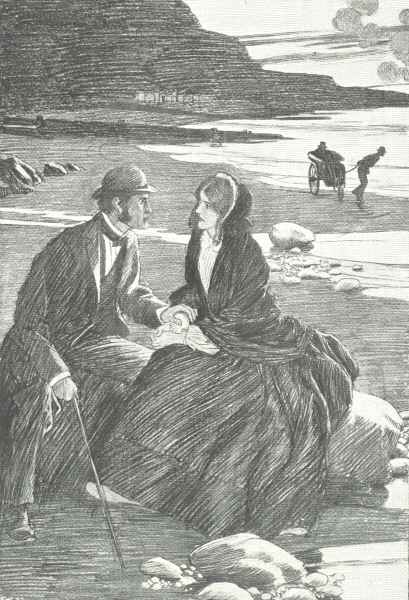
She looked at me with the utmost wonder and alarm, saying,‘Yes!’
‘And you know what a voice is in it when the stormcomes?’
‘Yes!’
‘You see how quiet and peaceful it lies before us, andyou know what an awful sight of power without pity it might be,this very night!’
‘Yes!’
‘But if you had never heard or seen it, or heard of itin its cruelty, could you believe that it beats every inanimatething in its way to pieces, without mercy, and destroys lifewithout remorse?’
‘You terrify me, sir, by these questions!’
‘To save you, young lady, to save you! ForGod’s sake, collect your strength and collect yourfirmness! If you were here alone, and hemmed in by therising tide on the flow to fifty feet above your head, you couldnot be in greater danger than the danger you are now to be savedfrom.’
The figure on the sand was spun out, and straggled off into acrooked little jerk that ended at the cliff very near us.
‘As I am, before Heaven and the Judge of all mankind,your friend, and your dead sister’s friend, I solemnlyentreat you, Miss Niner, without one moment’s loss of time,to come to this gentleman with me!’
If the little carriage had been less near to us, I doubt if Icould have got her away; but it was so near that we were therebefore she had recovered the hurry of being urged from therock. I did not remain there with her two minutes. Certainly within five, I had the inexpressible satisfaction ofseeing her—from the point we had sat on, and to which I hadreturned—half supported and half carried up some rude stepsnotched in the cliff, by the figure of an active man. Withthat figure beside her, I knew she was safe anywhere.
I sat alone on the rock, awaiting Mr. Slinkton’sreturn. The twilight was deepening and the shadows wereheavy, when he came round the point, with his hat hanging at hisbutton-hole, smoothing his wet hair with one of his hands, andpicking out the old path with the other and a pocket-comb.
‘My niece not here, Mr. Sampson?’ he said, lookingabout.
‘Miss Niner seemed to feel a chill in the air after thesun was down, and has gone home.’
He looked surprised, as though she were not accustomed to doanything without him; even to originate so slight aproceeding.
‘I persuaded Miss Niner,’ I explained.
‘Ah!’ said he. ‘She is easilypersuaded—for her good. Thank you, Mr. Sampson; sheis better within doors. The bathing-place was farther thanI thought, to say the truth.’
‘Miss Niner is very delicate,’ I observed.
He shook his head and drew a deep sigh. ‘Very,very, very. You may recollect my saying so. The timethat has since intervened has not strengthened her. Thegloomy shadow that fell upon her sister so early in life seems,in my anxious eyes, to gather over her, ever darker, everdarker. Dear Margaret, dear Margaret! But we musthope.’
The hand-carriage was spinning away before us at a mostindecorous pace for an invalid vehicle, and was making mostirregular curves upon the sand. Mr. Slinkton, noticing itafter he had put his handkerchief to his eyes, said:
‘If I may judge from appearances, your friend will beupset, Mr. Sampson.’
‘It looks probable, certainly,’ said I.
‘The servant must be drunk.’
‘The servants of old gentlemen will get drunksometimes,’ said I.
‘The major draws very light, Mr. Sampson.’
‘The major does draw light,’ said I.
By this time the carriage, much to my relief, was lost in thedarkness. We walked on for a little, side by side over thesand, in silence. After a short while he said, in a voicestill affected by the emotion that his niece’s state ofhealth had awakened in him,
‘Do you stay here long, Mr. Sampson?’
‘Why, no. I am going away to-night.’
‘So soon? But business always holds you inrequest. Men like Mr. Sampson are too important to others,to be spared to their own need of relaxation andenjoyment.’
‘I don’t know about that,’ said I. ‘However, I am going back.’
‘To London?’
‘To London.’
‘I shall be there too, soon after you.’
I knew that as well as he did. But I did not tell himso. Any more than I told him what defensive weapon my righthand rested on in my pocket, as I walked by his side. Anymore than I told him why I did not walk on the sea side of himwith the night closing in.
We left the beach, and our ways diverged. We exchangedgood-night, and had parted indeed, when he said, returning,
‘Mr. Sampson, mayI ask? Poor Meltham, whomwe spoke of,—dead yet?’
‘Not when I last heard of him; but too broken a man tolive long, and hopelessly lost to his old calling.’
‘Dear, dear, dear!’ said he, with greatfeeling. ‘Sad, sad, sad! The world is agrave!’ And so went his way.
It was not his fault if the world were not a grave; but I didnot call that observation after him, any more than I hadmentioned those other things just now enumerated. He wenthis way, and I went mine with all expedition. Thishappened, as I have said, either at the end of September orbeginning of October. The next time I saw him, and the lasttime, was late in November.
V.
I HAD a very particularengagement to breakfast in the Temple. It was a bitternorth-easterly morning, and the sleet and slush lay inches deepin the streets. I could get no conveyance, and was soon wetto the knees; but I should have been true to that appointment,though I had to wade to it up to my neck in the sameimpediments.
The appointment took me to some chambers in the Temple. They were at the top of a lonely corner house overlooking theriver. The name, Mr. AlfredBeckwith, was painted on the outer door. On the dooropposite, on the same landing, the name Mr.Julius Slinkton. The doors of both sets of chambersstood open, so that anything said aloud in one set could be heardin the other.
I had never been in those chambers before. They weredismal, close, unwholesome, and oppressive; the furniture,originally good, and not yet old, was faded and dirty,—therooms were in great disorder; there was a strong prevailing smellof opium, brandy, and tobacco; the grate and fire-irons weresplashed all over with unsightly blotches of rust; and on a sofaby the fire, in the room where breakfast had been prepared, laythe host, Mr. Beckwith, a man with all the appearances of theworst kind of drunkard, very far advanced upon his shameful wayto death.
‘Slinkton is not come yet,’ said this creature,staggering up when I went in; ‘I’ll callhim.—Halloa! Julius Cæsar! Come anddrink!’ As he hoarsely roared this out, he beat thepoker and tongs together in a mad way, as if that were his usualmanner of summoning his associate.
The voice of Mr. Slinkton was heard through the clatter fromthe opposite side of the staircase, and he came in. He hadnot expected the pleasure of meeting me. I have seenseveral artful men brought to a stand, but I never saw a man soaghast as he was when his eyes rested on mine.
‘Julius Cæsar,’ cried Beckwith, staggeringbetween us, ‘Mist’ Sampson! Mist’Sampson, Julius Cæsar! Julius, Mist’ Sampson,is the friend of my soul. Julius keeps me plied withliquor, morning, noon, and night. Julius is a realbenefactor. Julius threw the tea and coffee out of window when Iused to have any. Julius empties all the water-jugs oftheir contents, and fills ’em with spirits. Juliuswinds me up and keeps me going.—Boil the brandy,Julius!’
There was a rusty and furred saucepan in the ashes,—theashes looked like the accumulation of weeks,—and Beckwith,rolling and staggering between us as if he were going to plungeheadlong into the fire, got the saucepan out, and tried to forceit into Slinkton’s hand.
‘Boil the brandy, Julius Cæsar! Come! Do your usual office. Boil the brandy!’
He became so fierce in his gesticulations with the saucepan,that I expected to see him lay open Slinkton’s head withit. I therefore put out my hand to check him. Hereeled back to the sofa, and sat there panting, shaking, andred-eyed, in his rags of dressing-gown, looking at us both. I noticed then that there was nothing to drink on the table butbrandy, and nothing to eat but salted herrings, and a hot,sickly, highly-peppered stew.
‘At all events, Mr. Sampson,’ said Slinkton,offering me the smooth gravel path for the last time, ‘Ithank you for interfering between me and this unfortunateman’s violence. However you came here, Mr. Sampson,or with whatever motive you came here, at least I thank you forthat.’
‘Boil the brandy,’ muttered Beckwith.
Without gratifying his desire to know how I came there, Isaid, quietly, ‘How is your niece, Mr. Slinkton?’
He looked hard at me, and I looked hard at him.
‘I am sorry to say, Mr. Sampson, that my niece hasproved treacherous and ungrateful to her best friend. Sheleft me without a word of notice or explanation. She wasmisled, no doubt, by some designing rascal. Perhaps you mayhave heard of it.’
‘I did hear that she was misled by a designingrascal. In fact, I have proof of it.’
‘Are you sure of that?’ said he.
‘Quite.’
‘Boil the brandy,’ muttered Beckwith. ‘Company to breakfast, Julius Cæsar. Do yourusual office,—provide the usual breakfast, dinner, tea, andsupper. Boil the brandy!’
The eyes of Slinkton looked from him to me, and he said, aftera moment’s consideration,
‘Mr. Sampson, you are a man of the world, and so amI. I will be plain with you.’
‘O no, you won’t,’ said I, shaking myhead.
‘I tell you, sir, I will be plain with you.’
‘And I tell you you will not,’ said I. ‘I know all about you. Youplain with anyone? Nonsense, nonsense!’
‘I plainly tell you, Mr. Sampson,’ he went on,with a manner almost composed, ‘that I understand yourobject. You want to save your funds, and escape from yourliabilities; these are old tricks of trade with youOffice-gentlemen. But you will not do it, sir; you will notsucceed. You have not an easy adversary to play against,when you play against me. We shall have to inquire, in duetime, when and how Mr. Beckwith fell into his presenthabits. With that remark, sir, I put this poor creature,and his incoherent wanderings of speech, aside, and wish you agood morning and a better case next time.’
While he was saying this, Beckwith had filled a half-pintglass with brandy. At this moment, he threw the brandy athis face, and threw the glass after it. Slinkton put hishands up, half blinded with the spirit, and cut with the glassacross the forehead. At the sound of the breakage, a fourthperson came into the room, closed the door, and stood at it; hewas a very quiet but very keen-looking man, with iron-gray hair,and slightly lame.
Slinkton pulled out his handkerchief, assuaged the pain in hissmarting eyes, and dabbled the blood on his forehead. Hewas a long time about it, and I saw that in the doing of it, atremendous change came over him, occasioned by the change inBeckwith,—who ceased to pant and tremble, sat upright, andnever took his eyes off him. I never in my life saw a facein which abhorrence and determination were so forcibly painted asin Beckwith’s then.
‘Look at me, you villain,’ said Beckwith,‘and see me as I really am. I took these rooms, tomake them a trap for you. I came into them as a drunkard,to bait the trap for you. You fell into the trap, and youwill never leave it alive. On the morning when you lastwent to Mr. Sampson’s office, I had seen him first. Your plot has been known to both of us, all along, and you havebeen counter-plotted all along. What? Having beencajoled into putting that prize of two thousand pounds in yourpower, I was to be done to death with brandy, and, brandy notproving quick enough, with something quicker? Have I neverseen you, when you thought my senses gone, pouring from yourlittle bottle into my glass? Why, you Murderer and Forger,alone here with you in the dead of night, as I have so oftenbeen, I have had my hand upon the trigger of a pistol, twentytimes, to blow your brains out!’
This sudden starting up of the thing that he had supposed tobe his imbecile victim into a determined man, with a settledresolution to hunt him down and be the death of him, mercilesslyexpressed from head to foot, was, in the first shock, too muchfor him. Without any figure of speech, he staggered underit. But there is no greater mistake than to suppose that aman who is a calculating criminal, is, in any phase of his guilt,otherwise than true to himself, and perfectly consistent with hiswhole character. Such a man commits murder, and murder isthe natural culmination of his course; such a man has to outfacemurder, and will do it with hardihood and effrontery. It isa sort of fashion to express surprise that any notoriouscriminal, having such crime upon his conscience, can so brave itout. Do you think that if he had it on his conscience atall, or had a conscience to have it upon, he would ever havecommitted the crime?
Perfectly consistent with himself, as I believe all suchmonsters to be, this Slinkton recovered himself, and showed adefiance that was sufficiently cold and quiet. He waswhite, he was haggard, he was changed; but only as a sharper whohad played for a great stake and had been outwitted and had lostthe game.
‘Listen to me, you villain,’ said Beckwith,‘and let every word you hear me say be a stab in yourwicked heart. When I took these rooms, to throw myself inyour way and lead you on to the scheme that I knew my appearanceand supposed character and habits would suggest to such a devil,how did I know that? Because you were no stranger tome. I knew you well. And I knew you to be the cruelwretch who, for so much money, had killed one innocent girl whileshe trusted him implicitly, and who was by inches killinganother.’
Slinkton took out a snuff-box, took a pinch of snuff, andlaughed.
‘But see here,’ said Beckwith, never looking away,never raising his voice, never relaxing his face, neverunclenching his hand. ‘See what a dull wolf you havebeen, after all! The infatuated drunkard who never drank afiftieth part of the liquor you plied him with, but poured itaway, here, there, everywhere—almost before your eyes; whobought over the fellow you set to watch him and to ply him, byoutbidding you in his bribe, before he had been at his work threedays—with whom you have observed no caution, yet who was sobent on ridding the earth of you as a wild beast, that he wouldhave defeated you if you had been ever so prudent—thatdrunkard whom you have, many a time, left on the floor of thisroom, and who has even let you go out of it, alive andundeceived, when you have turned him over with yourfoot—has, almost as often, on the same night, within anhour, within a few minutes, watched you awake, had his hand atyour pillow when you were asleep, turned over your papers, takensamples from your bottles and packets of powder, changed theircontents, rifled every secret of your life!’
He had had another pinch of snuff in his hand, but hadgradually let it drop from between his fingers to the floor;where he now smoothed it out with his foot, looking down at itthe while.
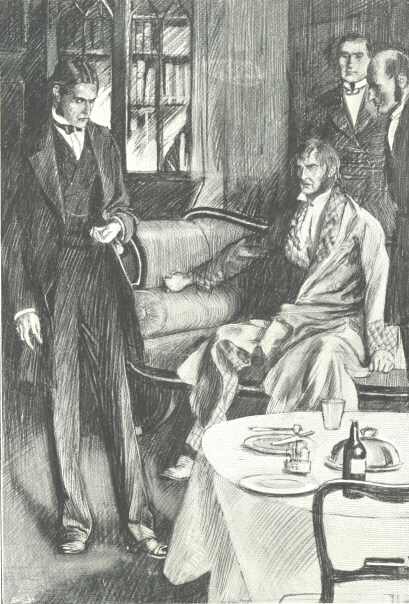
‘That drunkard,’ said Beckwith, ‘who hadfree access to your rooms at all times, that he might drink thestrong drinks that you left in his way and be the sooner ended,holding no more terms with you than he would hold with a tiger,has had his master-key for all your locks, his test for all yourpoisons, his clue to your cipher-writing. He can tell you,as well as you can tell him, how long it took to complete thatdeed, what doses there were, what intervals, what signs ofgradual decay upon mind and body; what distempered fancies wereproduced, what observable changes, what physical pain. Hecan tell you, as well as you can tell him, that all this wasrecorded day by day, as a lesson of experience for futureservice. He can tell you, better than you can tell him,where that journal is at this moment.’
Slinkton stopped the action of his foot, and looked atBeckwith.
‘No,’ said the latter, as if answering a questionfrom him. ‘Not in the drawer of the writing-desk thatopens with a spring; it is not there, and it never will be thereagain.’
‘Then you are a thief!’ said Slinkton.
Without any change whatever in the inflexible purpose, whichit was quite terrific even to me to contemplate, and from thepower of which I had always felt convinced it was impossible forthis wretch to escape, Beckwith returned,
‘And I am your niece’s shadow, too.’
With an imprecation Slinkton put his hand to his head, toreout some hair, and flung it to the ground. It was the endof the smooth walk; he destroyed it in the action, and it willsoon be seen that his use for it was past.
Beckwith went on: ‘Whenever you left here, I lefthere. Although I understood that you found it necessary topause in the completion of that purpose, to avert suspicion,still I watched you close, with the poor confiding girl. When I had the diary, and could read it word by word,—itwas only about the night before your last visit toScarborough,—you remember the night? you slept with a smallflat vial tied to your wrist,—I sent to Mr. Sampson, whowas kept out of view. This is Mr. Sampson’s trustyservant standing by the door. We three saved your nieceamong us.’
Slinkton looked at us all, took an uncertain step or two fromthe place where he had stood, returned to it, and glanced abouthim in a very curious way,—as one of the meaner reptilesmight, looking for a hole to hide in. I noticed at the sametime, that a singular change took place in the figure of theman,—as if it collapsed within his clothes, and theyconsequently became ill-shapen and ill-fitting.
‘You shall know,’ said Beckwith, ‘for I hopethe knowledge will be bitter and terrible to you, why you havebeen pursued by one man, and why, when the whole interest thatMr. Sampson represents would have expended any money in huntingyou down, you have been tracked to death at a singleindividual’s charge. I hear you have had the name ofMeltham on your lips sometimes?’
I saw, in addition to those other changes, a sudden stoppagecome upon his breathing.
‘When you sent the sweet girl whom you murdered (youknow with what artfully made-out surroundings and probabilitiesyou sent her) to Meltham’s office, before taking her abroadto originate the transaction that doomed her to the grave, itfell to Meltham’s lot to see her and to speak withher. It did not fall to his lot to save her, though I knowhe would freely give his own life to have done it. Headmired her;—I would say he loved her deeply, if I thoughtit possible that you could understand the word. When shewas sacrificed, he was thoroughly assured of your guilt. Having lost her, he had but one object left in life, and that wasto avenge her and destroy you.’
I saw the villain’s nostrils rise and fall convulsively;but I saw no moving at his mouth.
‘That man Meltham,’ Beckwith steadily pursued,‘was as absolutely certain that you could never elude himin this world, if he devoted himself to your destruction with hisutmost fidelity and earnestness, and if he divided the sacredduty with no other duty in life, as he was certain that inachieving it he would be a poor instrument in the hands ofProvidence, and would do well before Heaven in striking you outfrom among living men. I am that man, and I thank God thatI have done my work!’
If Slinkton had been running for his life from swift-footedsavages, a dozen miles, he could not have shown more emphaticsigns of being oppressed at heart and labouring for breath, thanhe showed now, when he looked at the pursuer who had sorelentlessly hunted him down.
‘You never saw me under my right name before; you see meunder my right name now. You shall see me once again in thebody, when you are tried for your life. You shall see meonce again in the spirit, when the cord is round your neck, andthe crowd are crying against you!’
When Meltham had spoken these last words, the miscreantsuddenly turned away his face, and seemed to strike his mouthwith his open hand. At the same instant, the room wasfilled with a new and powerful odour, and, almost at the sameinstant, he broke into a crooked run, leap, start,—I haveno name for the spasm,—and fell, with a dull weight thatshook the heavy old doors and windows in their frames.
That was the fitting end of him.
When we saw that he was dead, we drew away from the room, andMeltham, giving me his hand, said, with a weary air,
‘I have no more work on earth, my friend. But Ishall see her again elsewhere.’
It was in vain that I tried to rally him. He might havesaved her, he said; he had not saved her, and he reproachedhimself; he had lost her, and he was broken-hearted.
‘The purpose that sustained me is over, Sampson, andthere is nothing now to hold me to life. I am not fit forlife; I am weak and spiritless; I have no hope and no object; myday is done.’
In truth, I could hardly have believed that the broken man whothen spoke to me was the man who had so strongly and sodifferently impressed me when his purpose was before him. Iused such entreaties with him, as I could; but he still said, andalways said, in a patient, undemonstrative way,—nothingcould avail him,—he was broken-hearted.
He died early in the next spring. He was buried by theside of the poor young lady for whom he had cherished thosetender and unhappy regrets; and he left all he had to hersister. She lived to be a happy wife and mother; shemarried my sister’s son, who succeeded poor Meltham; she isliving now, and her children ride about the garden on mywalking-stick when I go to see her.
(Editor: Vault Toys)
- Uncle Josh's Punkin Centre Stories, by Cal Stewart
- The White Company, by Sir Arthur Conan Doyle
- The Project Gutenberg eBook of The Happy Prince, by Oscar Wilde
- The Project Gutenberg eBook of Poems, by Currer, Ellis, and Acton Bell (Brontë Sisters)
- The Drums of Jeopardy, by Harold Macgrath
- Evergreens, by Jerome K. Jerome
- The Project Gutenberg E
- A Woman of No Importance
- The Poetical Works of John Milton, by John Milton
- Mrs. Korner Sins Her Mercies, by Jerome K. Jerome
- The Project Gutenberg eBook of The Real Cyberpunk Fakebook, by St. Jude et al.
- The Poems of Henry Kendall, by Henry Kendall
- A Voyage to Abyssinia
- More Bab Ballads, by W. S. Gilbert
- Lady Baltimore, by Owen Wister
- The Project Gutenberg eBook of La Divina Commedia de Dante: Inferno, by Dante Alighieri
- A House of Pomegranates, by Oscar Wilde
- The Soul of Man, by Oscar Wilde
- The Project Gutenberg eBook of King Lear, by William Shakespeare
- Mrs. Korner Sins Her Mercies, by Jerome K. Jerome
- A Rogue's Life, by Wilkie Collins views+
- The Project Gutenberg eBook of The Amazing Interlude, by Mary Roberts Rinehart views+
- Poems by a Little Girl views+
- Poems, by William Ernest Henley views+
- A Lover’s Complaint views+
- The Project Gutenberg eBook of Poems, by T. S. Eliot views+
- The Comedy of Errors views+
- The Two Noble Kinsmen views+
- Romeo and Juliet views+
- My Lady's Money, by Wilkie Collins views+